Our Journey Toward Objective Pain Biomarkers
Pain is one of the most common reasons people seek medical care—yet it remains one of the most challenging conditions to measure objectively. At AlgiSense, we are developing an EEG-based digital biomarker platform to bring more reproducibility, comparability, and decision support to pain assessment.
The current primary method for pain assessment relies on patient self-reporting, typically using a 1-10 scale. While the patient’s narrative is undoubtedly vital, this subjective scoring introduces significant limitations. These constraints include variability across different devices, protocols, and individual patient differences, which limit the ability to compare scores over time and produce unreliable endpoints for clinical research. These challenges are particularly pressing in the context of chronic pain, where diagnosing and monitoring are further complicated by diverse underlying mechanisms and long-term neuroplastic changes.
Over the past year, our work shifted from asking whether objective pain measurement is feasible to a more practical question: Can we build pain biomarkers that are reproducible, transferable across EEG systems, and clinically meaningful? Our latest prototyping results suggest the answer is yes—and that EEG analytics can begin to move beyond binary detection toward mechanism-aware classification.
The Challenge We’re Addressing
EEG offers a promising modality for pain biomarker development: it is non-invasive and cost-effective compared to neuroimaging. It provides the temporal resolution required to detect network-level connectivity patterns. However, EEG signals are also highly variable—across people, recording conditions, and device montages—making reproducible modeling difficult without strong structure and harmonization.
Three persistent barriers in EEG pain biomarker R&D
What’s New Since Our 2024 Proof of Concept
Our 2024 POC demonstrated the feasibility of using graph-based representations of EEG. Since then, we have significantly refined the system across data integration, graph modeling, and deployment readiness, leveraging extended open-access EEG datasets with pertinent diagnostic data points.
In contrast to our POC approach, which implemented a Heterogeneous Graph Attention Network, we have simplified the graph representation to reflect the topological nature of the inference and added EEG features to support an edge-aware GIN architecture that incorporates connectivity weights. This improves prediction confidence calibration (lower loss) while maintaining classification accuracy.
How Our Approach Works
Instead of treating EEG as a flat set of channels, we model each recording as a graph: nodes represent electrode locations, edges encode functional connectivity, and features capture both spectral activity (e.g., band power) and topology. This preserves relationships that are often lost when the EEG is reduced to a set of independent features.
a multi-tier EEG graph DATABASE model
The multi-tier EEG graph model consists of a canonical reference tier that defines a stable foundation — brain regions, sensor channels, and frequency bands — all mapped in 3D space.
Directly linked is the study-and-session tier, which captures individual readings — subjects, timestamps, and per individual session EEG features. This separation allows each dataset to attach to a universal scaffold without rewriting the schema, enabling us to analyze, compare, and train consistently across diverse studies. It’s our bridge between research-grade precision and real-world adaptability.
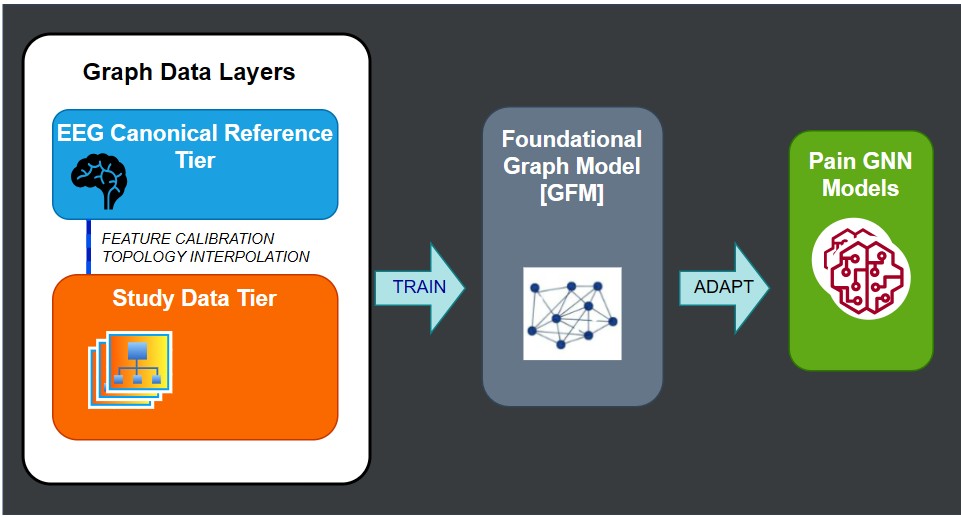
Another beneficial outcome of this separation is the ability to build and train graph foundational models, which are then adapted into specialized graph neural network models for various pain detection and assessment tasks.
Topology-aware interpolation: enabling device-agnostic learning
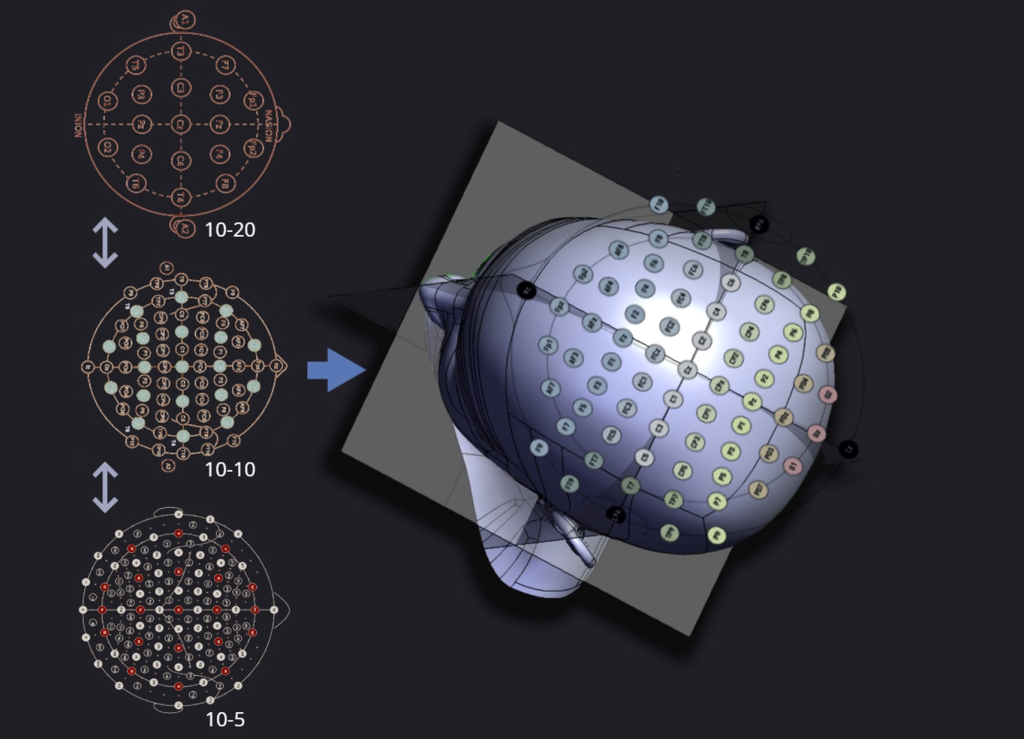
EEG device heterogeneity is a core barrier to the development of generalizable biomarkers. Different studies and headsets use different montages (10–20, 10–10, 10–5), and many datasets are not directly comparable. We address this with a topology-aware interpolation layer that maps variable configurations to a canonical reference topology—supporting inference scenarios that scale down to consumer devices (up to ~24 channels) and scale up to medical and research systems (64+ channels).
from data to deployable inferences
AlgiSense EEG-GNN platform architecture consists of a data storage tier (graph + object storage), a cloud processing hub for reproducible training and model registry, and an inference module that supports both cloud and edge deployment.
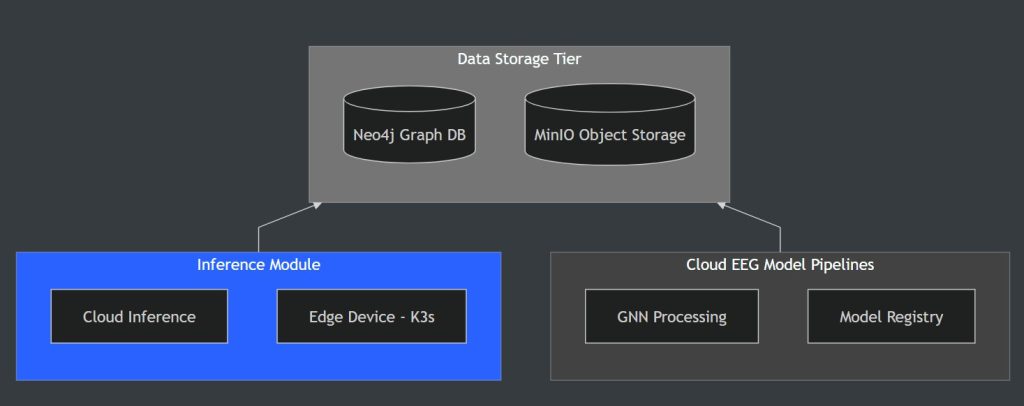
Our platform’s EEG processing pipelines leverage a topology-aware interpolation framework to harmonize EEG montages (10–5 → 10–10 → 10–20) onto a canonical reference topology. This enables cross-study comparability and supports deployment across research-grade systems (64+ channels) and consumer devices (up to ~24 channels).
PROTOTYPE: SETTING BASELINE
Production-Ready Chronic Pain Detection
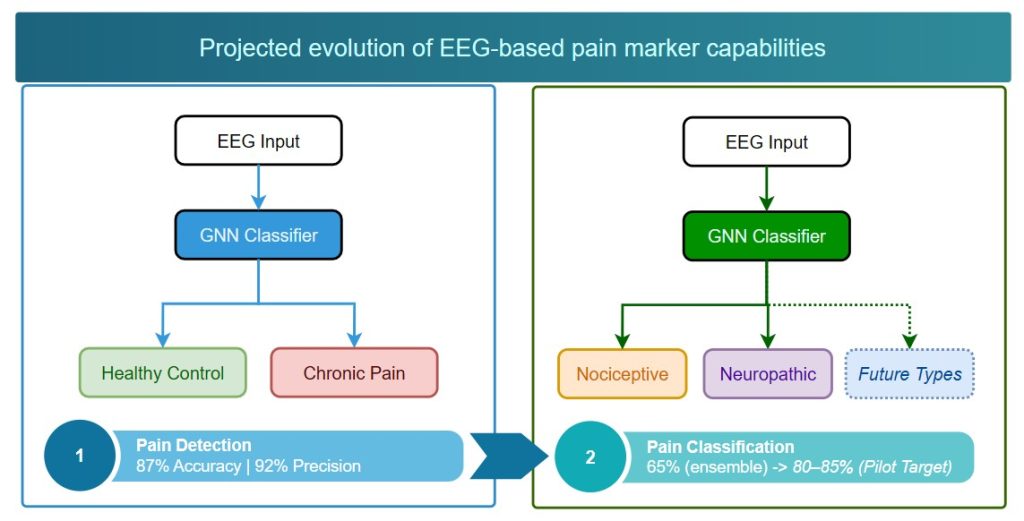
Our latest validated detection baseline distinguishes healthy controls from chronic pain using EEG connectivity-derived graphs. This baseline is necessary for clinical relevance because it establishes a reproducible signal beyond subjective self-reporting and demonstrates that graph-structured EEG representations carry discriminative information about chronic pain states.
| Metric | Performance |
|---|---|
| Test Accuracy | 87.50% |
| Precision | 92.01% |
| F1 Score | 88.33% |
| Model Size | 27,793 parameters (~131 KB ONNX) |
| Training Time | ~5 seconds/epoch (CPU) |
| Dataset | 688 graphs (539 HC, 149 CP) |
Pain Type Classification: A First Step Toward Mechanistic Understanding
Detection alone does not distinguish between pain mechanisms. In a proof-of-concept phenotype task, we achieved 64.7% accuracy in distinguishing neuropathic (nerve-related) from nociceptive (tissue injury/inflammation) pain. The initial performance analysis revealed significant volatility in individual model performance (23.5% to 70.6%). Statistical projections, ensuring balanced learning, anticipate substantial improvement, with the model expected to achieve 80-85% accuracy on an expanded, balanced dataset. While early, this moves the field closer to objective tools to support treatment-directed decisions and to more sensitive clinical trial endpoints.
| Metric | Performance |
|---|---|
| Test Accuracy | 64.7% (ensemble) |
| Variation Range | 23.5% – 70.6% |
| Projected Accuracy (100+ NC) | 80-85% |
| Projected Variation (100+ NC) | ±5% |
| Model Size | 5,272 parameters (~25 KB ONNX) |
| Dataset | 113 graphs (24 NC, 89 NP) |
Lessons Learnt and THE ROAD AHEAD
Not everything we tried worked—and we believe that transparent reporting matters in medical AI. We explored Category Theory (CT)-enhanced architectures to improve transferability and interpretability. Our systematic evaluation indicates that, at current dataset sizes, simpler, well-designed architectures outperform theoretically sophisticated methods. This does not invalidate CT-based approaches; it clarifies the conditions under which they are likely to add value.
Our goal is not to replace clinical judgment—it is to augment it with objective, interpretable evidence. We are designing the platform for privacy-conscious deployment, including edge-cloud options that minimize data movement while enabling reproducible model operations. This approach supports research pilots, device partnerships, and integration pathways such as point-of-care workflows and longitudinal tracking.
Our current results establish a foundation, but additional work is required before clinical adoption. Near-term, we are focused on consolidating detection results through publication, expanding phenotype datasets, and initiating prospective validation. Mid-term, multi-center collaboration is essential to achieve the sample scale required for robust phenotype modeling and to re-evaluate advanced architectures under appropriate conditions.
 DISCOVER MORE
We recently had the opportunity to present our approach at NODES 2025, Neo4j’s global developer conference. Our talk, “EEG Topologies with Neo4j: Interpolation-Driven Graph Learning for Chronic Pain Detection,” explored how graph database technology enables the kind of topology-aware data harmonization that makes our platform possible.
▶️ Watch the NODES 2025 Presentation