R&D Background
Chronic pain affects millions globally and is often accompanied by cognitive and emotional challenges, including mental disorders. The inability to objectively measure pain presents numerous issues in pain management, such as medication availability, clinical care, treatment monitoring, and clinical trials. Therefore, reliable, ethical, noninvasive detection and continuous measurement are crucial for effective treatment. Brain imaging, particularly EEG, shows promise due to its high temporal resolution and cost-effectiveness compared to fMRI and PET.
Recent EEG-based approaches to pain detection include univariate methods, which focus on individual metrics like location and magnitude of brain activation, and multivariate approaches leveraging machine learning (ML) to predict pain-related outcomes. These approaches, especially those using ML, require careful validation to ensure specificity and accuracy. Emerging efforts using deep learning (DL) frameworks on EEG data are expanding our understanding of pain as a dynamic brain network activity. However, no study has yet considered the topological relationships between EEG channels and band power activity in the context of pain detection using graph-based learners.
Biomarker Assessment Framework and Model Development
EEG Study Datasets
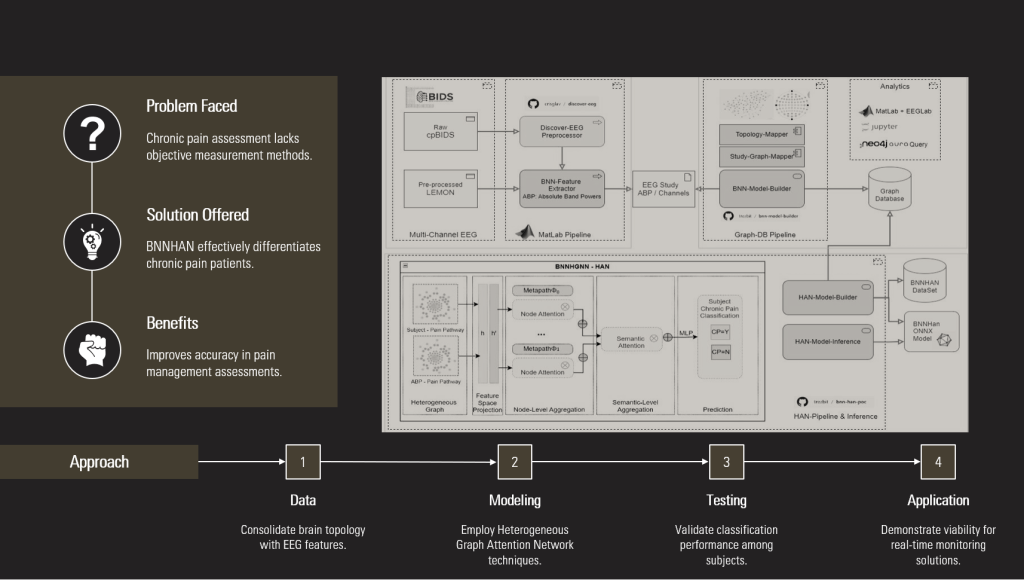
To evaluate the effectiveness of the proposed Heterogeneous Graph Neural Network (HGNN) learner, we developed a graph model aligning brain topology with the International 10-10 system for EEG electrode placement. We utilized datasets from two key studies: the cpCGX-BIDS (Chronic Pain Data EEG Dataset) and the MBB LEMON (Control EEG Dataset). We focused on the Eyes-Closed resting-state EEG reads to establish a baseline for chronic pain versus control subjects.
Preprocessing and EEG Feature Extraction
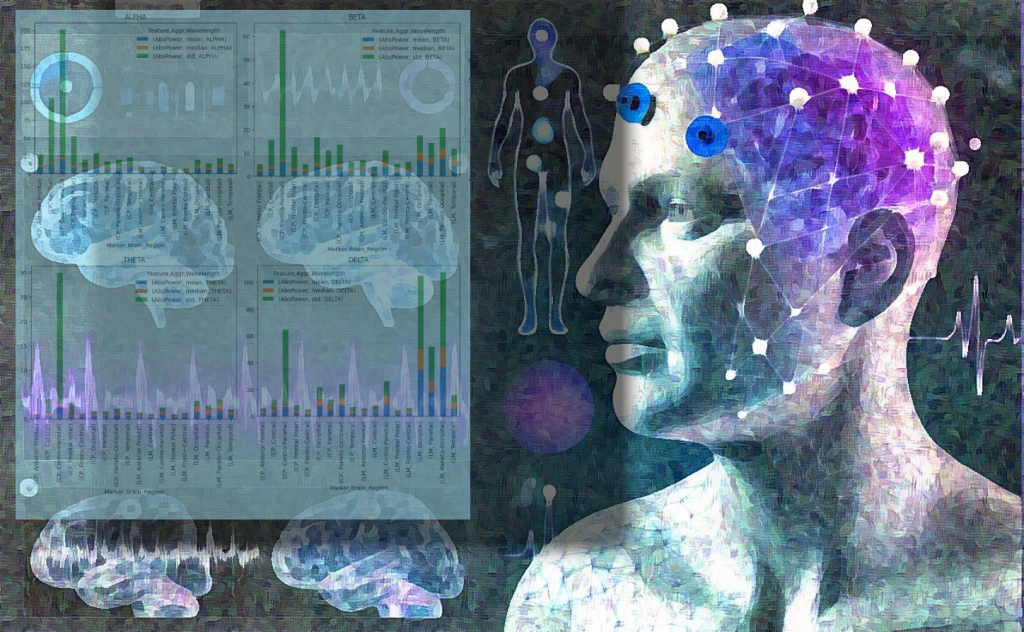
We employed DISCOVER-EEG, an open-source EEG pipeline, for preprocessing steps such as line noise removal, high-pass filtering, bad channel removal, and artifact detection. The feature extraction focused on Absolute Band Power (ABP) as a key EEG feature across frequency bands: Delta, Theta, Alpha, Beta, and Gamma.
Topology Mapping and Graph Model Development
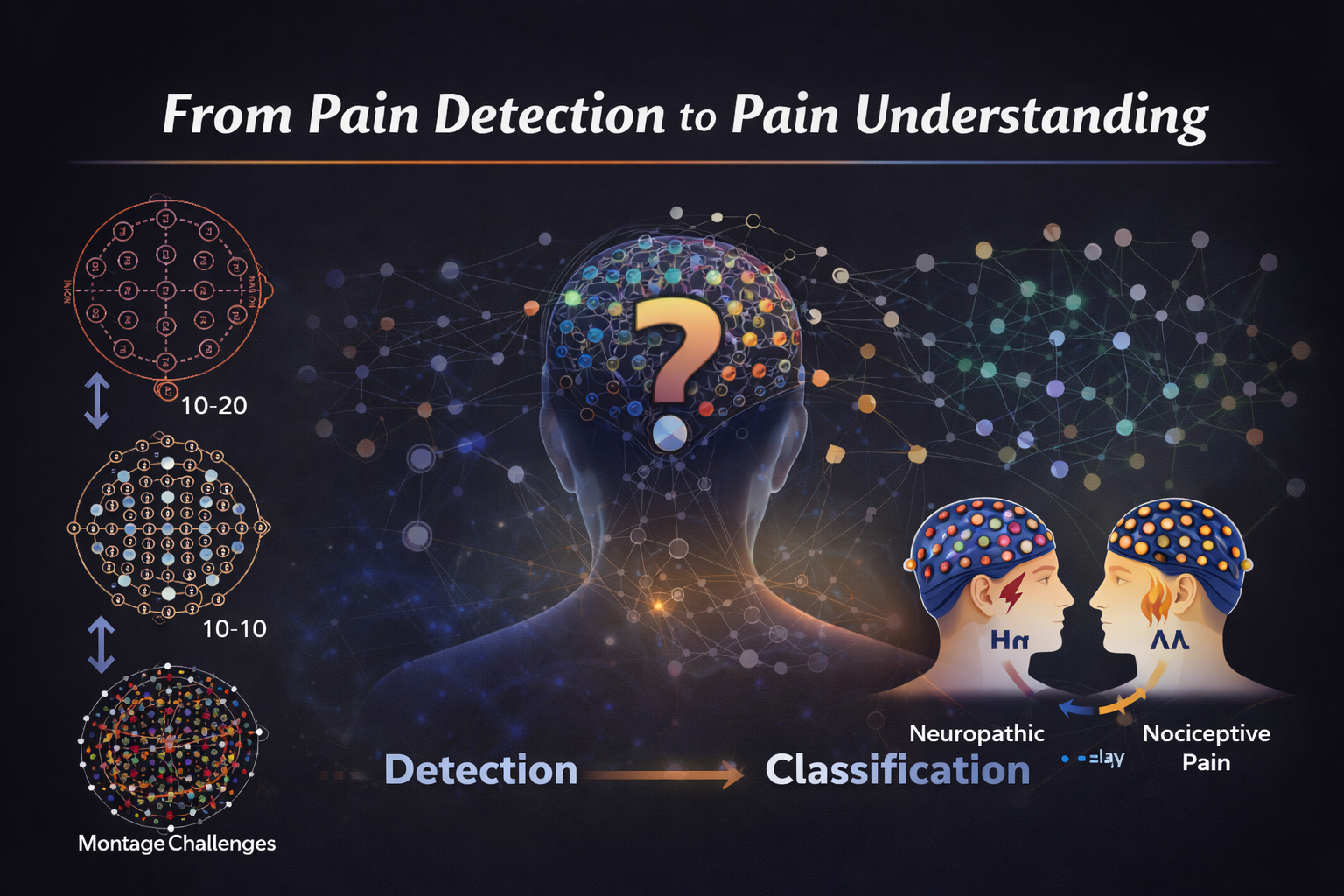
We aligned the EEG channel locations with the International 10-20 system to create a Reference Brain Topology Map. This allowed us to compare activation paths and discover potential patterns. The graph database schema captures the brain topology and ABP marker nodes, representing EEG channel reads and clustering them around control versus chronic pain subjects.
GNN Architecture and Inference
The computational approach for the GNN involves using Heterogeneous GNN architectures, which are better suited for the proposed EEG biomarker approach. These architectures handle different types of nodes and edges and require specialized message-passing mechanisms. Candidate architectures include Multi-view Heterogeneous Graph Neural Networks and Heterogeneous Graph Attention Networks, which provide higher representational power and scalability.
BNNHAN Proof-Of-Concept
As part of our R&D, we developed BRAINGNNet, a novel graph-based representation of EEG data that integrates brain topology with extracted Absolute Band Power (ABP) features. Our Proof-of-Concept (POC) implementation, BNNHAN, employs a Heterogeneous Graph Attention Network (HAN) to infer chronic pain states through a binary node classification task. Key findings from our POC* include:
 DISCOVER MORE